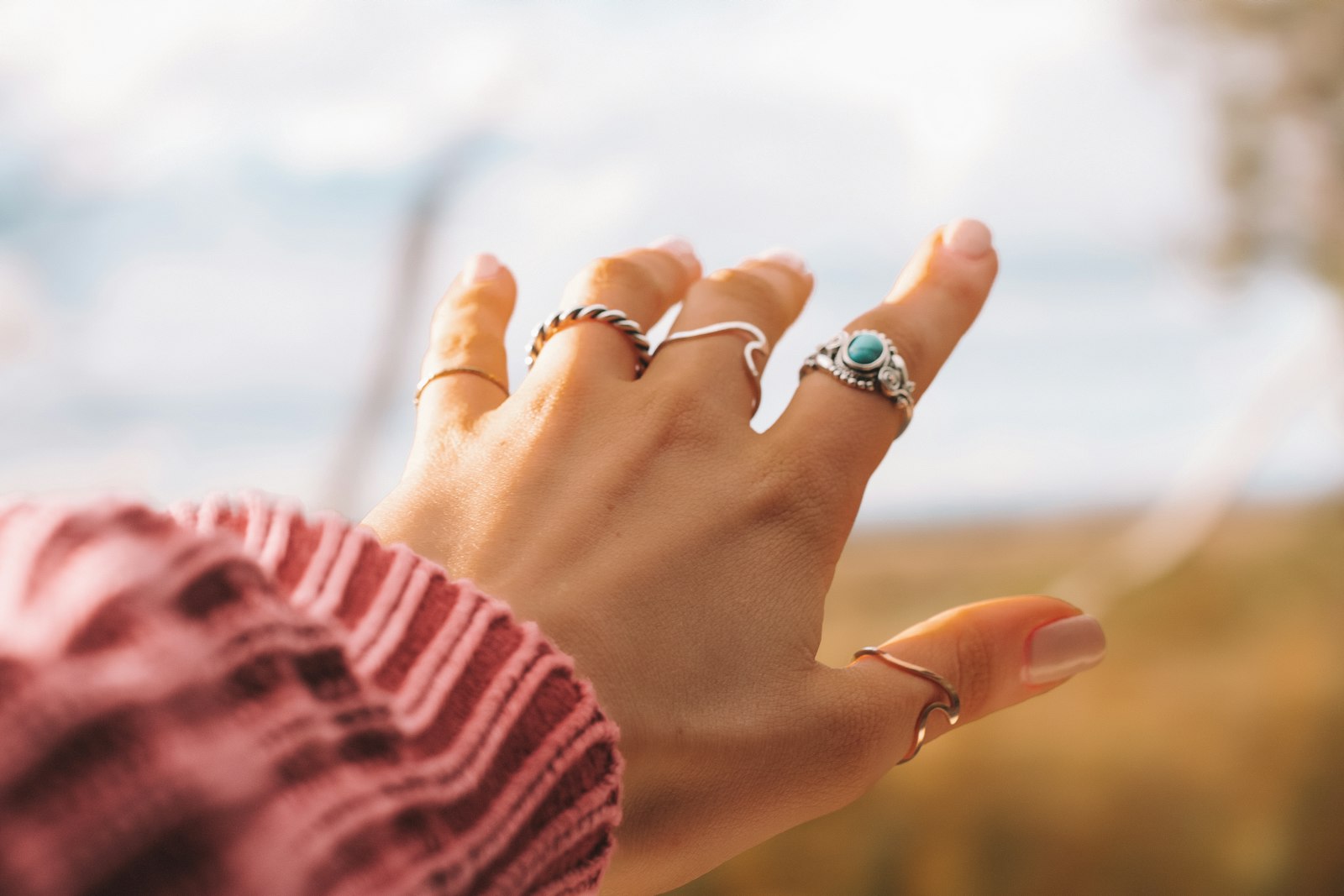
A ring that’s too tight is uncomfortable, and one that’s too loose can slip off. A few careful measurements help you get it right.
What to remember
- Measure your finger in the evening, when it’s warm, because fingers can swell during the day and in heat.
- A ring needs to slide over your knuckle as well as sit comfortably at the base of your finger.
- Wide bands usually fit more snugly than narrow ones, so you may need a slightly larger size.
- A jeweler’s sizing is the most reliable, especially for an engagement ring or a ring that can’t be resized.
Ring sizing is one of the most common reasons jewelry gets returned. Measuring carefully at home narrows down your size, and a quick visit to a jeweler confirms it.
Measuring with string or paper
- Cut a thin strip of paper or a piece of non-stretchy string.
- Wrap it around the base of your finger, snug but not tight.
- Mark where it overlaps, then measure the length in millimeters.
- Divide by 3.14 to get the diameter, and compare it with the chart below.
- Check that a ring of that size would still slide over your knuckle.
US ring size chart
| US size | Inside diameter |
|---|---|
| 5 | About 15.7 mm |
| 6 | About 16.5 mm |
| 7 | About 17.3 mm |
| 8 | About 18.1 mm |
| 9 | About 19.0 mm |
| 10 | About 19.8 mm |
Each full size adds roughly 0.8 mm to the inside diameter.
Buying tip: Measure in the evening, at room temperature. Fingers are often slightly larger in the evening and in warm weather, and smaller when you’re cold.
What affects fit
- Band width: wider bands cover more of your finger and usually feel tighter, so you may need a slightly larger size.
- Knuckles: if your knuckle is larger than the base of your finger, choose a size that slides over the knuckle without forcing it.
- Dominant hand: fingers on your dominant hand are sometimes a little larger.
Buying a ring as a surprise
If you can’t measure the wearer’s finger, borrow a ring they wear on the same finger and compare it with a size chart, or ask a friend or family member who might know. Choosing a jeweler with a clear resizing or exchange policy helps too; our guide to buying jewelry as a gift has more tips.
Before you buy: If a ring becomes stuck because your finger has swollen, or your finger turns pale, blue or numb, get medical help promptly rather than forcing the ring off.
Confirm with a jeweler
Home measurements are a good guide, but a jeweler’s sizing set is more accurate. It’s worth checking before buying an expensive ring or one that can’t easily be resized, such as an eternity band.
Common jewelry questions
Can I use a ring I already own?
Yes. Measure the inside diameter of a ring that fits the same finger well and compare it with a size chart. Check that it’s a similar band width.
Are ring sizes the same everywhere?
No. The US, UK and Europe use different systems. If you’re buying from another country, check which system the seller uses.
Can every ring be resized?
Not every ring. Eternity bands with stones all the way around and rings made from some hard materials are difficult or impossible to resize. Ask before you buy.