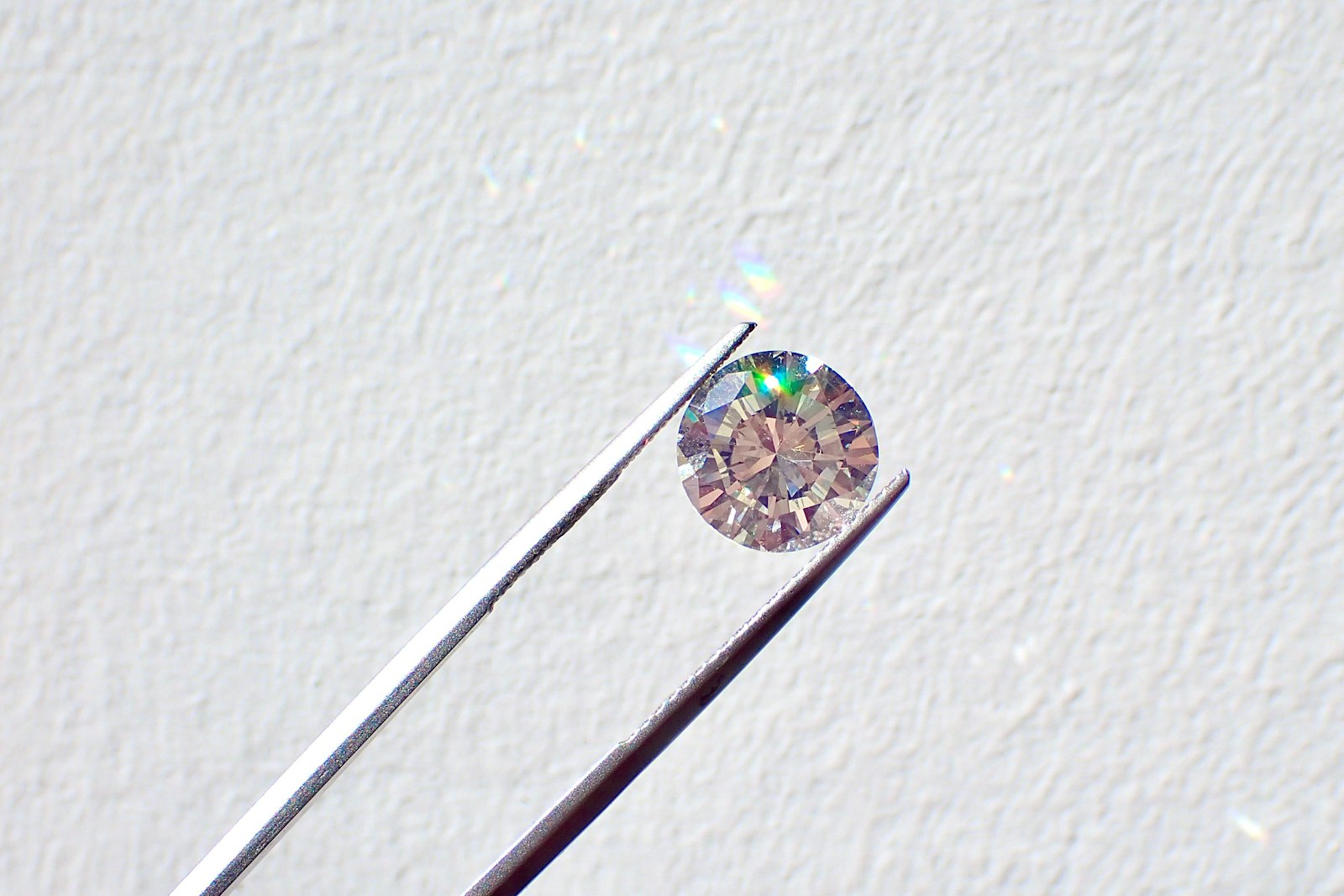
Cut, color, clarity and carat weight describe a diamond’s quality. Understanding them helps you compare stones with confidence.
What to remember
- The 4Cs are cut, color, clarity and carat weight, a system created by GIA.
- GIA’s color scale runs from D, colorless, to Z, which has a light yellow or brown tint.
- There are 11 clarity grades, from Flawless to Included.
- One carat is 0.2 grams, divided into 100 points.
Diamond prices vary enormously, even between stones that look similar at first glance. The 4Cs, developed by the Gemological Institute of America (GIA), give a common language for describing quality.
Cut
Cut describes how well a diamond’s facets interact with light: its brightness, fire and sparkle. For standard round brilliant diamonds, GIA grades cut from Excellent to Poor. As GIA puts it, the higher the cut grade, the brighter the diamond.
Color
For white diamonds, GIA’s color scale runs from D, which is colorless, to Z, which shows a light yellow or brown tint. The differences between neighboring grades are often too subtle to see without comparison stones.
Clarity
Clarity describes internal features, called inclusions, and surface marks, called blemishes. GIA’s system has 11 grades:
| Group | Grades |
|---|---|
| Flawless | FL |
| Internally Flawless | IF |
| Very, Very Slightly Included | VVS1, VVS2 |
| Very Slightly Included | VS1, VS2 |
| Slightly Included | SI1, SI2 |
| Included | I1, I2, I3 |
Carat weight
Carat is a unit of weight, not size. One metric carat is 0.2 grams and is divided into 100 points, so a 0.50-carat diamond may be described as 50 points.
Buying tip: Prices often jump at popular weights, such as 0.50 and 1.00 carat. A stone just under one of those weights can look almost identical and cost noticeably less.
Balancing the 4Cs
Most buyers balance the 4Cs rather than maximizing all of them. A common approach is to prioritize cut for sparkle, then choose a color and clarity where flaws aren’t visible to the naked eye, and let budget decide carat weight.
Before you buy: Make sure any diamond’s description says whether it’s natural or lab-grown, and whether it has been treated. Our guide to lab-grown and mined diamonds explains the differences.
Ask for the report
For a significant purchase, ask for a grading report from an independent laboratory and check that its details match the stone. Our gift-buying checklist covers the other questions to ask.
Common jewelry questions
Which of the 4Cs matters most?
Many jewelers point to cut, because it has the biggest effect on how much a diamond sparkles. The right balance depends on your priorities and budget.
Do I need a grading report?
For a significant purchase, a report from an independent laboratory gives you an objective description of the stone, which helps when comparing prices.
Is a bigger carat weight always better?
Not necessarily. A well-cut diamond can look brighter, and sometimes larger, than a heavier stone with a poor cut.